
Local Government Reorganisation (LGR) is the Government’s programme to simplify how councils are organised in England, including in Cambridgeshire and Peterborough. It proposes replacing county and district councils with new councils responsible for all local council services in their areas. These are called ‘unitary councils’.
The Government paused LGR on 7 September 2026 to assess whether the plans remain sound and fit its new priorities. On 29 October 2026, it confirmed that no decision had yet been made for Cambridgeshire and Peterborough and said a decision for our area was expected by early 2027 at the latest.
In the meantime, it confirmed that local elections in May 2027 will take place using the current council boundaries, where elections are due. However, there are no elections at South Cambridgeshire District Council in May 2027 as we had them in May 2026.
Council services remain unchanged, and we are still here to help. You can continue to contact the council in the usual ways.
You can also read a statement from Cllr Bridget Smith, the Leader of South Cambridgeshire District Council.
We are awaiting further details, including a timetable for any changes to council arrangements. We will update these pages as more information becomes available. You can read the latest announcement from the Ministry of Housing, Communities and Local Government (MHCLG).
The story so far
The Government has consulted on different options for how local government in Cambridgeshire and Peterborough could look in future. That consultation closed in March 2026. We responded to that consultation and you can read our response. [PDF, 0.2MB]
The Government will make the final decision on which of the four options that were submitted by the Cambridgeshire and Peterborough councils - if any - is selected.
Along with Cambridge City Council and East Cambridgeshire District councils, we have backed the creation of a new unitary Council for Greater Cambridge and another for North Cambridgeshire and Peterborough – known locally as Option B. We sent a detailed proposal [PDF, 23MB] to Government and it is an option they are consulting upon. Watch our presentation to discover why we believe Option B is best for the region.
Earlier in 2026, the Leaders of Cambridge City Council, East Cambridgeshire District Council and South Cambridgeshire District Council explained why their Councils think Option B is the best for the whole region.
Why is this happening?
In December 2024, the national Government set out plans to move towards a new system of local government, abolishing all ‘two-tier’ areas in England. That means that the below councils in Cambridgeshire will be replaced by a number of unitary authorities:
- Cambridge City Council
- Cambridgeshire County Council
- East Cambridgeshire District Council
- Fenland District Council
- Huntingdonshire District Council
- Peterborough City Council
- South Cambridgeshire District Council
We have a page of some frequently asked questions about local government reorganisation.
After the changes, residents will access all services - from roads maintenance and bin collections to education, planning, social housing, social care, and support with benefits - through a unitary council.
Parish and town councils will not be affected and will continue to operate as they do now.
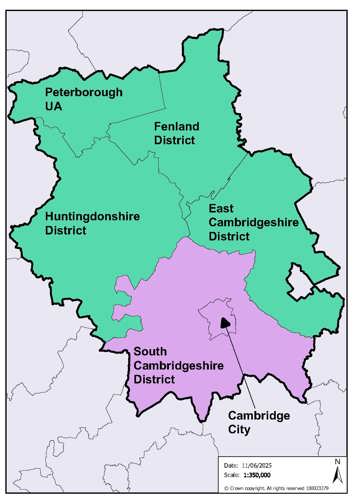
A new unitary council for Cambridge and South Cambridgeshire
Along with Cambridge City Council and East Cambridgeshire District Council, we have backed the creation of a new unitary Council for Greater Cambridge and another for North Cambridgeshire and Peterborough – with local leaders saying they offer financial security, deliver £43 million savings a year and respect local identities.
- North Cambridgeshire and Peterborough – serving around 612,000 people in East Cambridgeshire, Fenland, Huntingdonshire and Peterborough.
- Greater Cambridge – serving around 322,000 people in Cambridge and South Cambridgeshire.
The detailed proposal making the case for these two new unitaries [PDF, 23MB] was produced through close working between Cambridge City Council, East Cambridgeshire District Council and South Cambridgeshire District Council, as well as other councils in Cambridgeshire.
This detailed proposal is supported by several appendices:
- Appendix 1: Glossary
- Appendix 2: Financial analysis and modelling
- Appendix 3: Detailed options appraisal
- Appendix 4: Cambridgeshire and Peterborough countywide survey results
- Appendix 5: East Cambridgeshire survey results
- Appendix 6: The future of Cambridge and South Cambridgeshire survey results
- Appendix 7: Inner Circle Consulting: Case for Cities report
- Appendix 8: Pixel - Financial modelling and reporting
- Appendix 9: Newton - People Services report
- Appendix 10: Red Quadrant - Future of social care and public health report
- Appendix 11: PPL - Advice note on housing and homelessness
- Appendix 12: Cambridgeshire and Peterborough People Services overview
- Appendix 13: Cambridgeshire and Peterborough Local Government Reorganisation Comparative implications for people services to 2040
- Appendix 14: Transport to work areas - Further analysis
- Appendix 15: Implementation risk log
- Appendix 16: Equalities Impact Assessment
Why Cambridge City, East Cambridgeshire District and South Cambridgeshire District councils believe option B is best
A summary of the benefits are:
- Financial security: Independent analysis shows option B is the most financially sustainable option of the proposals developed by local councils. It would save £43 million a year, more than three times the saving of other options developed locally, paying back the cost of change in just four years. Future savings will be reinvested in frontline services, as residents have called for.
- Fairness for all: Option B creates two councils that are the right size to thrive, but local enough to care, and can meet local needs, for both urban and rural communities. It avoids the risk of one area being left behind and ensures resources are shared fairly.
- Respect for local identity: The new councils would reflect historic communities and keep decision-making close to residents.
- Supports growth and jobs: Each council would focus on its strengths. Greater Cambridge has a world-leading science and tech economy and is a geography that directly aligns with the Government’s ambitions for the area, whilst North Cambridgeshire and Peterborough is an industrial and agricultural powerhouse – creating more jobs and homes for its market towns and cities.
- Future-proofed: Option B meets government’s tests for financial resilience, economic balance, and sustainable public services better than any other option.
- Residents agree: In Council surveys carried out for Cambridge City, East Cambridgeshire District and South Cambridgeshire District councils, the majority of respondents supported option B because it offers the best chance of delivering simpler, stronger councils that care about local communities.
- Better services: Residents said they want councils that are easier to contact, more responsive, and focused on frontline services. Option B delivers that.
- Simpler, stronger councils: One council for your area means less confusion and quicker decisions. But Option B ensures councils that are the right size to thrive, local enough to care for all.
Alternative options
Four options for local government reorganisation in Cambridgeshire and Peterborough were submitted by local councils. Find out more about all options put forward and local engagement.
What does this mean for residents?
We understand that announcements about the reorganisation of local councils may feel concerning, particularly for residents who rely on regular council services. We want to reassure you that there will be no immediate changes to the services you receive.
The council that currently provides your services will keep delivering them as usual, with the same care, support, and contact points you are familiar with today.
If you rely on council services, for example if you receive care or assistance, your day-to-day support will remain in place.
If any changes to services are proposed in the future, these will be:
-
Clearly explained in advance,
-
Communicated in accessible formats, and
-
Shared with plenty of time for you and your carers, family members, or support networks to understand what is happening.
We are committed to making sure that no one is left uncertain or unsupported during this process. Our priority is your wellbeing. We will continue to work closely with residents, communities, and partners to ensure that services remain safe, reliable, and centred around your needs. If you have any immediate concerns, please get in touch with us.
What does this mean for businesses and organisations?
Businesses, organisations, volunteers and public sector colleagues are being reassured that services will continue to run as normal up to the creation of the new authorities, known as vesting day, and after the new arrangements are in place. Our aim is for the transition to be as seamless as possible for everyone involved. We’re committed to working closely with you to design councils fit for the future.
What does this mean for people working at the Council?
It is too early to say what the LGR process will mean for individual people or teams. However, based on previous reorganisations and current planning assumptions, we think that most employees will transfer to a new unitary authority on vesting day. This is likely to be under the protection of the Transfer of Undertakings (Protection of Employment) regulations, commonly known as TUPE, or similar.